Curriculum Coherence part 2: Conceptual Frameworks for Geography and History

Substantive knowledge

The objects of study, the substantive content, is potentially vast and confusing and failure to select and organise content results in the fragmented learning of isolated nuggets of facts noted in the subject reports for Geography and History (Oftsed, 2023a&b). Making sense of the multitude of geographical and historical objects relies on applying a framework to sort content into categories that make learning efficient and meaningful. As mental representations applied to reality, those categories have the status of concepts and it is this conceptual framework that is the starting point for design in the coherent curriculum (Rata, 2019). 

It is common to describe these categorical concepts as themes: organising ideas that run through the subject, across time and place, that offer a common framework for understanding different historical periods or geographical locations.  Examples of themes from the subject association literature include ‘biomes, settlements, trade, agriculture, energy, climate, urbanisation, coasts’ for geography and ‘trade, war, government, monarchy, empire, religion, power, society’ for history. 

From the subject leader’s perspective, however, themes may prove to be not so useful. Auditing provision of themes across seven year groups where individual year groups may not cover all of the chosen themes may fail to produce a clear picture of strengths and weaknesses.  Themes can be a little too porous as categories and may lack clear boundaries in the conceptual framework: ‘war’, ‘invasion’ and ‘empire’ may exist separately or as nested facets of a particular event in the past. Ever-finer graded thematic strands are possible: toys, games, composting, neighbourhoods, for example, can be traced through several time periods or locations. Themes by themselves have the potential to obscure or confuse access to a meaningful overview of the subject.

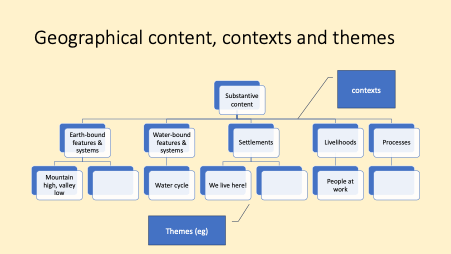
In this respect, subject contexts are more useful than themes for curriculum design, audit and revision. With a bit of tweaking of the aims set out in the NC orders these can be usefully defined in order to support subject leaders and teachers’ in their planning. For example, in Geography the traditional division between physical and human geography and geographical processes can be elaborated as five contexts: earth-bound features and systems; water-bound features and systems; settlements; livelihoods (any activity related to the sustaining of life); and processes (ecosystems):
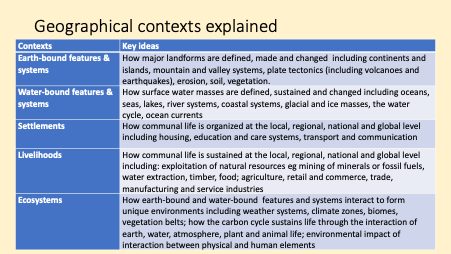
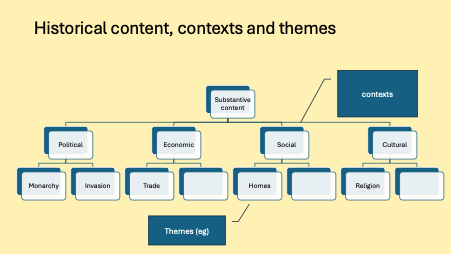
In History the contexts are derived from particular forms of history: political, economic, social and cultural:
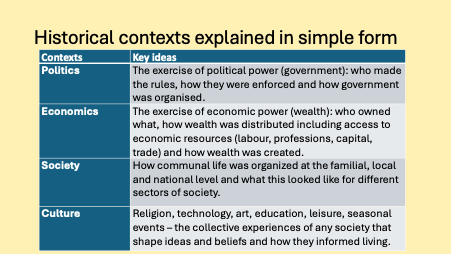
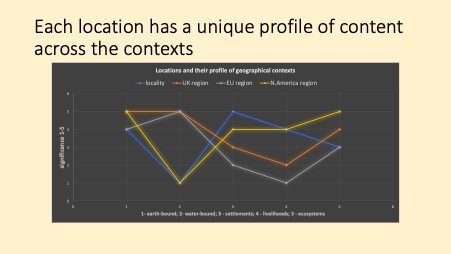
Contexts are powerful tools of analysis, too. Any geographical location or historical period can be analysed, recognised and understood in terms of its contextual profile. In other words, every location has a unique identity determined by the presence (or absence) of earth-bound, water-bound features and systems, settlements, activity related to livelihoods, and the processes at work in that location:
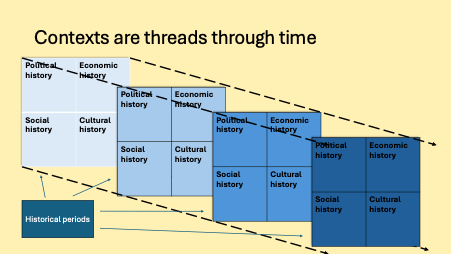
Similarly, any historical period will have its own unique profile made up of the political, economic, social and cultural conditions that define it as a particular moment in time. Contexts are the organisational lettering that runs through the substantive stick of rock:
Whilst the context is the unit of organisation most useful to the subject lead, the theme is the unit of planning that teachers and students will mostly encounter in the classroom. The connection between context and theme is not straightforward and many themes may contain elements of two or more contexts. As a tool for subject management, contexts provide a useful guide to breadth and balance in designing and auditing provision and offer a framework that supports learners as they move towards a more expert command of the subject. Themes, however, are the bridge between the abstract notion of contexts and the actual ‘stuff’ of history and geography, the facts and figures. Just as any teenager is intuitively able to locate the ice cream or juice in a crowded fridge, eventually we want learners to be able to use contexts and themes to help them make sense of the myriad facts encountered in the course of their studies. 

Contexts are matched to local circumstances through the selection of themes. Deriving themes from the framework of contexts will enable subject leaders to design a local curriculum that meets the NC requirements for breadth and balance. Looking for opportunities to exploit the potential of the locality to illustrate the subject contexts allows learners to understand their circumstances in relation to the bigger pictures of geography and history at the regional, national and global levels. Similarly, exploiting the powerful encounters of first-hand experience mediated through the subject contexts prepares learners to develop later understanding of these important abstract notions through these first encounters with material evidence in the locality.
Having identified a set of themes grounded in the framework of subject contexts, the next challenge for curriculum design is to work out how those themes are expressed as continuous but progressively complex strands across the year groups. Despite the frequency at which problems of sequencing are highlighted in inspection reports, exploration of theory underpinning the sequencing of knowledge is poorly explored in Ofsted’s research activity. It is not sufficient to suggest, as the recent subject reviews do, that sequencing is the same as building on earlier knowledge and enabling later learning. These are the outcomes of sequencing not the essence which needs a better explanation than the catchphrases of progression and continuity that seem to run like a stuck record in the blogs, reports and conversations. Part three of this series will look at how subject leaders can use a framework of conceptual development derived from Vygotskian theory and research from coherent curriculum design, to structure progression in knowledge acquisition.

References

Ofsted (2023a) Rich encounters with the past: history subject report. Available at:https://www.gov.uk/government/publications/subject-report-series-history/rich-encounters-with-the-past-history-subject-report

Ofsted (2023b) Getting our bearings: geography subject report. Available at: https://www.gov.uk/government/publications/subject-report-series-geography

Rata, E. (2019). Knowledge‐rich teaching: A model of curriculum design coherence. British Educational Research Journal 45(4): 681–697.

Curriculum Coherence part 1: Navigating Substantive and Disciplinary Knowledge

This last year I have been privileged to be working with geography and history subject leads on unlocking the complexities of curriculum design coherence (Rata, 2019; McPhail, 2021), the model that underpins Ofsted’s current interpretation of the national curriculum. The knowledge-turn implicit in Ofsted’s research and inspection activity since 2018, whilst signalling a renewed commitment to the knowledge-rich curriculum, signalled also a significant shift in the view of knowledge from the Hirschian canonical model of cultural literacy that dominated initial interpretations of the 2014 English national curriculum to Young’s social realist concept of Powerful Knowledge. 

Ofsted’s recent subject reports (History, July 2023; Geography, September 2023) suggest that some schools are still struggling with this change. The clear water between them can be crudely paraphrased as the difference between a retrospective reliance on the ‘best that has been thought and said’ as a birthright inheritance, the entitlement to which assures a place in a democratic society stabilised by this shared heritage; against a forward-looking notion that knowledge is problematic in as much as some knowledge is more powerful than others and entitlement to this form of knowledge allows the individual to transcend their situation as a dynamic for social justice. From a learner perspective the former represents a canon of essential knowledge to be acquired together with efficiency in its recall and application whereas the latter focuses learning on an active engagement with knowledge and the disciplinary tools for knowledge creation and validation. 

That schools struggle with this shift is understandable given the recent past. The long tail of high stakes accountability is proving difficult to shake especially where school and trust management practices continue to prioritise the easy confidence of test data. Within the powerful knowledge paradigm itself, the principle that everyday, personal knowledge has no place in a curriculum of specialised knowledge creates problems for those subjects beyond maths and science that rely to a greater extent on the exercise of judgement or emotional response for knowledge creation. Furthermore, the recent evolution of powerful knowledge, the coherent curriculum, requires some knowledge of curriculum theory and is complex in comparison to the low challenge presented by a traditional curriculum of essential knowledge. 

The return to a focus on entitlement to a broad and balanced curriculum has ushered in new thinking around the nature of subject provision beyond the examination syllabus and opened the space for theoretically-driven developments in our understanding of knowledge-rich curricula. Unshackled from standardised assessment, the curriculum is maturing into something principled if a little more complex than previously understood. It is this complexity that we have been unpicking in our termly subject lead network meetings. What have we learned so far?

Getting the content right is imperative given the overwhelming amount of historical or geographical objects in the world. This challenge is two-fold: firstly, arriving at an arrangement of the content that is helpful to subject leads, obvious to teachers and supportive of learning; secondly, managing the extent of content within the constraints of time through selection that does not compromise subject values or the school’s vision for its pupils. These two challenges are best addressed through attending to the subject concepts: start with the conceptual framework that will be the locker room for the content you choose to include. Think of it as a well-organised fridge with shelves and drawers for dairy, meat, salads, etc.

The components of that framework should deal with two types of knowledge: substantive knowledge, the content to be learned, the facts; and disciplinary knowledge, the procedures, skills, dispositions that define the way enquiry in the subject is conducted. Substantive knowledge consists of two elements: substantive content, the objects of study, and substantive concepts, the categories by which those objects can be organised and given meaning. Disciplinary knowledge also has a framework of disciplinary concepts that are used to organise procedural knowledge – skills, tools, applications – into a process of enquiry. This constitutes the bare bones of a curriculum designed for coherence. In Part Two, these two conceptual frameworks will be discussed in detail along with some key lessons from the past year for subject leaders busy conducting audits, reviews or revisions.

McPhail G (2021) The search for deep learning: a curriculum coherence model. Journal of Curriculum Studies 53(4): 420–434.

Rata E (2019) Knowledge‐rich teaching: A model of curriculum design coherence. British Educational Research Journal45(4): 681–697.

Subject values: doing more as a result of knowing more

In a paper on curriculum design, the Israeli academic, Anna Sfard, proposed two metaphors for learning, ‘learning as acquisition’ and ‘learning as participation’ and warned against the dangers of pursuing one at the cost of the other. Given the current heavy emphasis on knowledge acquisition – the coherent curriculum and the accumulative mastery of key concepts; Ofsted’s simplistic model of cognition and the role of long-term memory; Science of Learning’s preoccupation with blocking, spacing, interleaving and recall practice – we might view Sfard’s 1998 article as startlingly prophetic. 

Most educators would express concern at the suggestion that the point of knowing more is to pass more tests yet there are indications that, despite Ofsted’s attempts to redress the pernicious effects of the high-stakes testing regime of recent past, there is a danger that the ‘threshold concept’ will become the new SAT target if knowledge acquisition continues to dominate curriculum development, as it currently does. The question remains largely unanswered in CPD circles – what is it that we expect children to do more of as a result of knowing more? The answer surely cannot be more tests, even if these are dressed up as retrieval tasks.

It has long been a central tenet of social constructivist theory that learning permits a certain kind of development that would not be possible without the systematic instruction that Vygotsky proposed as vital to the development of mature forms of thinking. So we can welcome Ofsted’s subject reviews when, as in the case of Geography, for example, the intention is made clear for children to acquire knowledge in order to ‘think like geographers’. The review explores the role of disciplinary knowledge – the conventions by which knowledge in any subject is created, contested, revised and validated – in developing children’s ‘sense of social and environmental agency’. Clearly, then, Ofsted expects the impact of curriculum to include some sort of behavioural change as well as an increase in the amount of knowledge gained. 

The idea of values as abstract notions that represent the juncture of ideas and beliefs with behaviour and action leads to the possibility for subject values that point towards the kind of behaviour and action that is expected to follow from an acquisition of the ideas and beliefs inherent in the knowledge. By bringing together clear statements of the knowledge children are expected to learn with the desired personal change, curriculum planning can begin to address the challenge of impact in terms of what it is children are expected to do as a result of knowing more. For example, target behaviours for Geography might relate to our desire for children to interact directly with the world outside the classroom, to develop deep connections to particular places and to begin to act in ecologically-informed ways with the natural world. Relevant subject values for these impact statements might be Adventure, Spirit of Place and Responsibility (an idea of what these behaviours might look like is included in the Geography section of this site). 

Refusing to allow curriculum planning to end at the year group chart that sets out the precise knowledge to be acquired opens the space for attention to the possible indicators of personal change as a result of that knowledge. Intentions for the development of a child’s social and environmental agency in the wider world through acquisition of specialist knowledge addresses the twin challenges that any principled curriculum should aim to address: the epistemological (KNOWING) and the ontological (BEING). In reading comprehension we talk about cohesion and coherence: how cohesion is achieved within the text – what is the stuff that binds it together as meaningful; and how does the text cohere with our understanding of the wider world? With this in mind, we might revise our understanding of the Coherent Curriculum as one which is cohesive internally – all the bits add up to a meaningful whole – but also coherent in its intentions externally – developing children as informed agents in their present and future worlds.

Ofsted (2021) Research review series: geography https://www.gov.uk/government/publications/research-review-series-geography/research-review-series-geography#disciplinary-knowledge

Sfard, A. (1998). On Two Metaphors for Learning and the Dangers of Choosing Just One. Educational Researcher27(2), 4–13.